


+15 More

Digital Aura Portal - FZCO
Building A1, Dubai Digital Park, Dubai Silicon Oasis, Dubai, United Arab Emirates Premises Number 72647 - 001
Business registration number: 70647


gamer-choice.com © 2026
Digital Aura Portal - FZCO
Building A1, Dubai Digital Park, Dubai Silicon Oasis, Dubai, United Arab Emirates Premises Number 72647 - 001
Business registration number: 70647
 October 30, 202511 min ReadElsa
The arrival of Armor 3.0 marks a monumental shift in Destiny 2’s armor design. With this overhaul, the developers have rebuilt the entire system from scratch, introducing significant improvements that redefine how you customize your Guardian, optimize stat rolls, and assemble synergistic armor combinations. These updates provide unprecedented freedom, deeper personalization, and a clearer route toward building powerful setups for any playstyle.
In this guide, you’ll discover how the revamped gear tier structure functions, what the six new armor stats represent, how armor archetypes affect build crafting, and why Tier 5 gear holds such importance. You’ll also learn about set bonuses, the new Exotic armor system, and how to target specific stats or perks from your drops. Each section will help you fully understand the system and make the most of these sweeping changes.
At Gamer Choice, you can easily obtain Tier 5 Armor and Tier 5 Edge of Fate Weapons. This lets you skip repetitive farming and dive directly into the new expansion’s most exciting activities. We guarantee the lowest prices and the fastest delivery for your purchase!

Buy Destiny 2 Boost
Get Destiny 2 boosts from trusted pros now!

With the launch of Edge of Fate, Destiny 2 introduces a completely structured tier system covering both armor and weapons. Gone are the days of random stat ranges and inconsistent progression—gear now clearly falls within tiers, from Tier 1 through Tier 5, each offering distinct benefits. This unifies previous mechanics like Adept weapons and Artifice armor under one streamlined model.
The higher the tier, the more valuable the gear becomes. Stat totals climb significantly with each tier, and advanced gameplay features—like additional mod energy or fine-tuning slots—unlock at the top. You’ll earn better tiers by tackling tougher content or improving your activity score with modifiers and banes. The higher your score, the greater your chance at high-tier rewards.
Here’s how armor tiers are structured:
Tier 1: 48–53 total stats
Tier 2: 53–58 total stats
Tier 3: 59–64 total stats
Tier 4: 65–72 total stats
Tier 5: 73–75 total stats (same as Tier 4, but with added tuning options)
Between Tiers 1 and 3, the differences are mostly about raw stat values. Tier 4 marks a major leap forward by offering 11 mod Energy instead of 10, enabling greater flexibility in fitting powerful mods together. You can now combine utility and stat mods that previously didn’t fit on the same piece.
Tier 5 armor in Destiny 2 Armor 3.0 pushes customization to the next level. Although its base stat totals remain equal to Tier 4, it introduces a unique tuning slot that allows you to reallocate five points between stats or apply balanced +1 boosts to three non-archetype stats. Additionally, Tier 5 unlocks access to plus/minus tuning mods, such as +5 Grenade / -5 Health, enabling refined stat tradeoffs and hyper-focused builds.
For example, players chasing over 100 grenade stat for enhanced grenade damage can use a +5/-5 mod to cross that threshold with minimal loss. If you reduce a stat that’s already low, the tradeoff becomes negligible. This creates an entirely new layer of intelligent min-maxing for experienced players.
Ultimately, the Destiny 2 armor tier system rewards skill and effort while providing a straightforward path to better gear through tangible upgrades. Armor now feels purpose-driven, empowering Guardians to refine their performance with meaningful precision.
The Armor 3.0 update also completely revamps Destiny 2’s stat ecosystem. The familiar six—Mobility, Resilience, Recovery, Strength, Discipline, and Intellect—have been retired. In their place comes a modernized system designed around ability synergy, damage scaling, and linear stat growth, ensuring that every point matters.
Instead of rigid 10-point tiers dictating cooldowns, Guardians now manage six dynamic stats that influence ability regeneration, damage, durability, and weapon handling. Each stat contributes incrementally, with every single point delivering a measurable improvement.
Here’s how the old stats transition into the new categories:
Mobility → Weapons
Resilience → Health
Recovery → Class
Strength → Melee
Discipline → Grenade
Intellect → Super
To avoid early imbalance, all characters receive baseline stat values when Armor 3.0 activates:
Mobility: Fixed to 30 for Warlocks and Titans, 40 for Hunters
Resilience: Equivalent to 100
Recovery: Equivalent to roughly 60
These baselines ensure no one feels weaker upon logging in. You can then specialize using mods, armor pieces, and tuning upgrades. Furthermore, perks like Recuperation, Momentum Transfer, and Bomber now scale dynamically based on their corresponding stats—invest more points and enjoy stronger results.
By separating stats from fixed cooldowns, Destiny 2 Armor 3.0 introduces a smarter, more flexible progression model. Stats now govern ability power, energy gain rates, and performance across both PvE and PvP. Every armor drop, every mod slot, and every point allocation becomes part of a truly customizable ecosystem.
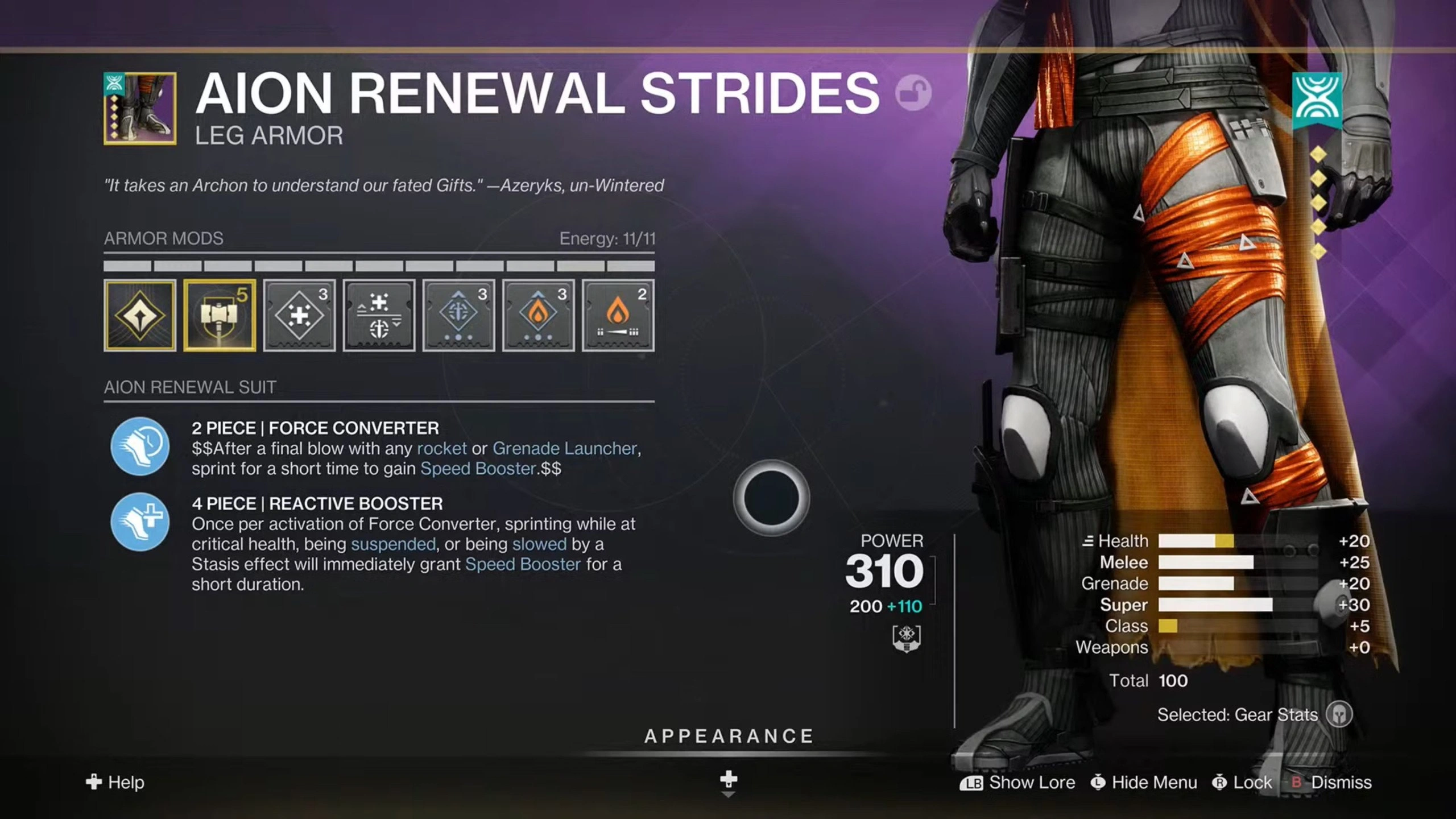
In the Armor 3.0 framework, each of the six new stats plays a significant role in determining your Guardian’s effectiveness. Whether it’s faster ability recharge, greater damage, or improved survivability, every stat now carries two levels of bonuses—one active from 1–100 and another unlocked from 100–200.
This dual-layer structure ensures constant progression while giving dedicated players a new goal to chase. Reaching beyond 100 unlocks potent secondary bonuses that can define entire builds.
Here’s a breakdown of what each stat does:
| Stat | 1–100 Effect | 100–200 Bonus |
|---|---|---|
| Health | +Orb healing (0–70 HP), +Flinch resist (0–10%) | Faster shield recharge (up to +25%), faster full recharge (up to 50%), +20 shield HP (PvE) |
| Melee | Faster melee cooldown, more energy regen | +30% melee damage (powered, unpowered, Glaive) |
| Grenade | Faster grenade cooldown, better regen | +65% grenade damage (PvE) |
| Super | Faster super energy gain | +45% super damage |
| Class | Faster class ability regen | +40 HP overshield (PvE), +10 HP (PvP) |
| Weapons | Faster reload/handling, +15% PvE damage vs minors/majors | Extra ammo from bricks, +15% damage vs bosses, +6% PvP damage |
The brilliance of this system lies in its synergy between regeneration and offense. When you push a stat high enough, you’re rewarded with both increased uptime and power. This balance promotes deeper build diversity—each stat investment feels impactful, and optimizing them for your playstyle becomes a satisfying part of gameplay.
At first glance, hitting 200 points in a stat might seem impossible, but the Armor 3.0 system introduces armor archetypes that make it achievable. Each armor piece now belongs to one of six archetypes, each heavily favoring a particular stat with a smaller boost to another.
This change replaces the old RNG-heavy distribution model. Instead of endlessly grinding for that one perfect roll, you can now deliberately chase armor archetypes aligned with your build goals—whether that’s maximizing grenade regeneration, increasing class ability uptime, or enhancing super generation. Ghost mods can also improve your chances of receiving a specific archetype drop.
Here are the six armor archetypes and their associated stats:
| Archetype | Primary Stat | Secondary Stat |
|---|---|---|
| Grenadier | Grenade | Super |
| Brawler | Melee | Health |
| Gunner | Weapons | Grenade |
| Specialist | Class | Weapons |
| Paragon | Super | Melee |
| Bulwark | Health | Class |
Every piece additionally includes a random tertiary stat from the remaining four. Usually, the primary stat gets the largest boost (+30), the secondary gets a moderate increase (+20), and the third fills the leftover range.
This structured system forms the foundation of reaching 200 in any given stat. For example, wearing four pieces of the Grenadier archetype could net you around 120 grenade stat points before applying mods. Add tuning and ghost mods, and suddenly 200 becomes realistic.
By focusing on archetypes, Destiny 2 players gain agency over their builds, allowing progress to feel steady, predictable, and rewarding. You can now design your Guardian with intent rather than relying on random luck.
For the first time, Destiny 2 Armor 3.0 introduces armor sets with passive bonuses—a long-requested addition finally realized in the Edge of Fate expansion. These armor set bonuses grant extra effects when wearing multiple pieces from the same set, introducing fresh layers of build depth. While Exotics provide standout single-item perks, set bonuses deliver consistent synergy through stacking effects.
Each set offers two potential bonuses: a smaller one at two pieces and a stronger one at four. These effects are locked to each armor set but are designed around specific playstyles, such as improved weapon damage or enhanced survivability in challenging encounters.
The new system interacts smoothly with archetypes and mods, enabling you to combine passive set bonuses with high-stat gear. You can still equip an Exotic armor piece in the fifth slot, so achieving a four-piece set bonus never means losing access to your strongest Exotic.
Here are examples of known sets and their effects:
| Armor Set | 2-Piece Bonus | 4-Piece Bonus |
|---|---|---|
| Bushido | Final blows with freshly drawn/reloaded weapons heal you | Bow, shotgun, or sword kills reduce incoming damage; damaging enemies extends it |
| Aion Renewal | Rocket or grenade launcher kills grant speed boost when sprinting | Sprinting while slowed, suspended, or at low health grants a reactive speed boost |
| Techsec | Kinetic damage deals more to shields, overshields, vehicles, and constructs | Breaking shields or killing majors with kinetic damage triggers a shockwave |
| Last Discipline | Primary weapon kills increase reload speed | Picking up an Orb of Power grants special ammo progress |
While not as individually powerful as Exotics, these set bonuses trigger frequently and stack naturally, providing tremendous long-term value in endgame PvE and Crucible activities. Since players can mix two different 2-piece sets, the system also encourages hybrid playstyles, letting you blend offensive, defensive, or support effects.
This evolution of armor sets transforms how you approach gearing up—creating meaningful passive synergy across your entire loadout.

Buy Destiny 2 Accounts
Grab your Destiny 2 account and start raiding today!
The Armor 3.0 framework extends its reach to Exotics as well, ensuring all new Exotic drops align with the updated system. From now on, Exotics follow the same stat tiers and archetype rules as Legendary armor, integrating seamlessly into the broader progression ecosystem.
Legacy Exotics from past seasons automatically adopt the new stat categories (Health, Grenade, etc.), though their overall totals remain unchanged. You won’t need to depend solely on random drops for newer versions either—thanks to the Exotic focusing system.
Here’s what’s changing in Destiny 2’s Exotic armor 3.0:
The Exotic focusing feature will only be available during the Year of Prophecy, so Guardians seeking perfect rolls should take advantage while it lasts. Together with 4-piece set bonuses and tuning mods, Exotics remain central to Destiny 2’s high-end gameplay, now with far greater customization.
Armor tiers in Destiny 2 Armor 3.0 range from Tier 1 through Tier 5, each providing stronger stats and additional functionality. Tier 4 gear can reach up to 72 total stats with 11 mod energy, while Tier 5 introduces a unique tuning slot that allows you to fine-tune your stats for even greater build customization.
The six new stats introduced with Edge of Fate are:
Each stat influences cooldowns, regeneration, or overall combat effectiveness, scaling continuously from 1 to 200 instead of in fixed tiers.
Yes, Edge of Fate adds armor set bonuses for the first time. Equipping two or four pieces from the same armor set unlocks passive effects that complement specific playstyles, offering new synergy options without relying solely on Exotics.
Absolutely. By combining high-tier armor pieces, archetype bonuses, tuning mods, and focused stat gear, you can push an individual stat all the way to 200, unlocking the maximum benefits of the Armor 3.0 system.
There isn’t a universal “best” set—each excels in different situations. However, many players favor:
Your ideal armor set depends on your personal build goals, subclass, and the activities you’re tackling.
Destiny 2’s Armor 3.0 overhaul is the most ambitious transformation of the armor system to date. Through its integration of stat progression, gear tiers, archetypes, and set bonuses, the Edge of Fate expansion delivers unmatched control over Guardian builds. Every drop matters. Every point counts. And every armor piece contributes directly to a stronger, more personalized character.
Gone are the days of relying solely on RNG. With Armor 3.0, you can chart your own progression path through intentional farming, tuning mods, and targeted stat optimization. Combined with armor set bonuses and Exotic reworks, the system finally rewards deliberate buildcrafting and experimentation.
The result is a transparent, satisfying, and deeply strategic armor ecosystem. Whether you’re preparing for Grandmaster Nightfalls, fine-tuning Crucible performance, or crafting your first grenade-based powerhouse, Armor 3.0 empowers you to shape your Guardian exactly how you envision.