Counter Strike Roles Explained
Modern FPS games often borrow ideas from hero shooters, adding abilities, specialists, or class-based kits that change how each player approaches a round. Counter-Strike stays far more grounded. Every player has access to the same weapons, grenades, and tools, with no abilities or character classes creating uneven matchups. That is one of the reasons Counter-Strike is often seen as one of the fairest FPS games around, but it does not mean teams play without structure. Over time, players have naturally built roles to make teamplay smoother, cleaner, and more coordinated.
Counter-Strike roles are flexible rather than locked. Every player still needs to understand grenade lineups, communicate clearly, win duels, and adapt on the fly, especially in public matchmaking. However, in organised play or higher-level competition, filling the right roles helps a team function as a proper unit. Learning these roles is also important for anyone trying to break into the pro scene, because scouts and teams usually look for players who can fill specific needs on a roster.
Counter Strike Roles quick summary:
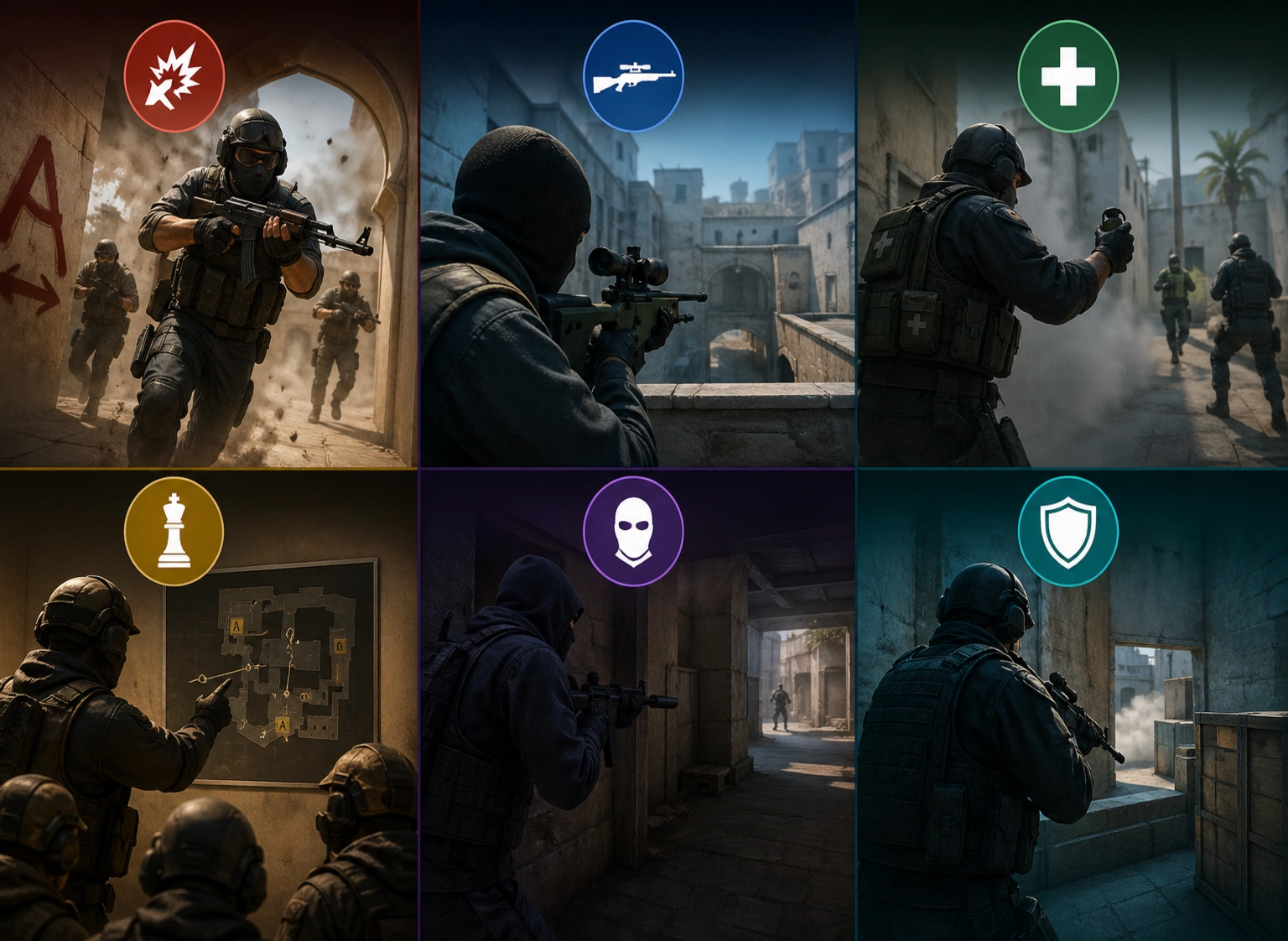
The main roles in Counter-Strike are Entry Fragger, AWPer, Support, IGL, Lurker, and Anchor.
Each role requires a different mindset, skill set, and way of reading the game.
NiKo, Stewie2K, and Dupreeh are some of the most iconic Entry Fraggers.
s1mple is widely viewed as the greatest CS:GO AWPer thanks to his aggressive and flashy sniping style.
Specialising in one role is useful, but modern Counter-Strike players are expected to be more flexible than ever.
Buy CS2 Boosts
Climb CS2 ranks fast with our pro boosters!
Shop now
Counter-Strike Roles Explained
Entry Fragger
Entry Fraggers are the players who take the first fight when a team tries to open up a bomb site. They are usually the first ones through the door, clearing angles, forcing defenders to react, and trying to create the first kill that gives their team space. In the perfect round, an Entry Fragger removes the defenders and survives long enough to help after the plant. If they die, their job is still not wasted as long as they instantly communicate enemy positions so teammates can trade the kill.
This role depends heavily on peek timing, crosshair placement, sharp reactions, and confidence. Entry players often have to fight through flashes, smokes, Molotovs, and chaotic site setups while still taking clean duels. It is a role made for players who trust their aim, are not afraid to be the first one in, and understand that even dying can be valuable if it creates a winning trade for the team.
AWPer
The AWPer is the team’s dedicated sniper, usually trusted with Counter-Strike’s iconic big green one-shot rifle. A strong AWPer forces opponents to respect long angles, slows down pushes, shuts down careless peeks, and can completely change how the enemy moves around the map. Whether holding a defensive line or taking an aggressive opening angle, AWPers are often responsible for controlling space and punishing mistakes.
This Counter-Strike 2 role fits patient players who can stay locked in even during quiet rounds. AWPers may spend long periods watching one angle, but they must be ready to instantly flick or react when movement appears. Because of how powerful and expensive the AWP is, dying out of position can be a huge gift to the enemy team. Many AWPers also end up in late-round situations, where their ability to stay calm and find picks can decide the round.
Support
The Support role is built around making teammates better. Supports use utility, trading, and positioning to help the team take space safely. They need to know important grenade lineups for each map, including smokes to block dangerous angles, flashes to blind defenders, and Molotovs to clear common hiding spots. A good Support often enables the Entry Fragger by setting them up with utility and staying close enough to trade if the first duel goes wrong.
This role is best suited for players who enjoy preparation, teamwork, and smart decision-making. Supports often spend time learning lineups, understanding timing, and playing around teammates through trades, boosts, bait setups, and information gathering. They may not always top the scoreboard, and they often sacrifice stronger weapons so they can buy more utility, but their value is massive. A good Support can make an entire team look cleaner and more organised.
Lurker
The Lurker is the player who thrives on timing, patience, and mind games. Instead of moving with the main group, Lurkers often drift away from the team to apply pressure elsewhere, punish rotations, and catch enemies from unexpected angles. They also gather important information, such as how defenders react to utility or whether a bomb site is being weakened. A strong Lurker can make CTs second-guess every rotation and slow down retake attempts after the bomb is planted.
The best Lurkers need excellent game sense, map knowledge, and timing. They must understand when to stay hidden, when to activate, and when to regroup with the team. Since they often play alone, they need to be self-sufficient and capable of making plays without much support. This role is ideal for players who prefer outsmarting opponents instead of simply relying on raw aim every round.
Anchor
Among all Counter-Strike roles, Anchor is the most CT-sided one. The Anchor’s job is to hold a bomb site for as long as possible, even when the enemy team commits heavily to that area. This role is built around patience, survival, information, and delaying the attack. If enemies hit their site, Anchors must stall with utility, positioning, and smart duels until rotations arrive.
Anchors are often put in difficult situations because they may be alone or heavily outnumbered. Their job is not always to win the round instantly, but to buy time, take at least one or two enemies down, and make the retake easier for teammates. If the attack goes to the other bomb site, the Anchor is usually one of the last players to rotate, which means they can also end up in clutch situations. A great Anchor is calm, reliable, and extremely hard to remove from a site.
IGL (In-Game Leader)
The IGL, or In-Game Leader, is the brain of the team. This player calls strategies, directs the team’s movement, makes mid-round decisions, and adjusts the plan when something unexpected happens. It is one of the easiest Counter-Strike roles to understand from the outside, but one of the hardest to perform well. Without a strong IGL, even talented teams can fall into chaos and lose rounds because nobody is making clear decisions.
In Counter-Strike 2 competitive matchmaking, an IGL may simply be the player confident enough to call which site to attack or when to rotate. In organised teams, the role becomes much deeper. IGLs prepare tactics before matches, review rounds afterward, study opponents, watch demos, and constantly build their understanding of the game. They need to know Counter-Strike inside out and keep the team focused under pressure. In many ways, the IGL is what puts the “tactical” into tactical shooter.
Most Iconic Counter-Strike Players In Each Role
Players who want to master a specific Counter-Strike role should study demos, VODs, and match footage from some of the best pros in the game’s history. Watching how elite players move, communicate, take fights, and react to pressure is one of the fastest ways to understand what each role really demands. Gamer Choice has broken down some of the most iconic names across Counter-Strike team roles, based on their impact, stats, achievements, and influence on the scene.
NiKo | Image credit: ESL
For Entry Fraggers, NiKo stands out as one of the most feared riflers ever, with incredible numbers in both total kills and opening kills. Stewie2K became famous for his fearless, chaotic style, often pushing through smokes and taking fights that frustrated even top professionals. Donk is a newer generational talent whose duelling and fragging power already make him one of the scariest players to face. Dupreeh, a five-time Major winner, represents a more methodical style of entrying, playing off teammates and creating space with discipline.
s1mple | Image credit: ESL
AWPers are often the star players of their teams, and many of Counter-Strike’s greatest names have played this role. s1mple, widely considered the GOAT of CS:GO, created countless highlight plays with the AWP and helped push aggressive sniping to new levels alongside kennyS. GuardiaN and dev1ce showed how deadly an AWPer can be when they simply do not miss. In the modern era, ZywOo and m0NESY continue to prove that entire rosters can be built around a world-class AWPer.
Perfecto | Image credit: ESL
Support players do not always dominate highlight reels, but their impact is huge. A strong Support often shows value through stats like AST, which reflects assists, survival, and traded deaths. Perfecto and Xyp9x, known as the “clutch minister,” are two of the most iconic Support players in Counter-Strike history. Their demos are full of smart positioning, calm decision-making, and round-winning details. Other notable Support names include Olofmeister, flusha, TACO, and Twistzz.
GeT_RiGhT | Image credit: ESL
Lurkers and Anchors often overlap because both roles reward patience, timing, and strong awareness. GeT_RiGhT is widely seen as one of the pioneers of lurking, with a legacy stretching back to Counter-Strike 1.6. Coldzera, during his prime, was terrifying from awkward angles and extremely difficult to beat in clutch situations. Ropz has become a star on maps with powerful anchor positions, especially places like Nuke. BlameF and huNter- also deserve recognition among great lurkers. For Anchors, players like Jimpphat, jks, sjuush, and Magisk have all shown what it means to hold down a site with confidence.
Karrigan | Image credit: ESL
The IGL role can look different depending on the team, since some leaders also take on hybrid responsibilities. Anyone trying to become a strong IGL should avoid only watching one player’s crosshair and instead study how the whole team moves, trades, communicates, and reacts together. Gla1ve, the mastermind behind prime Astralis, helped create one of the most dominant teams in Counter-Strike history through incredible structure and utility usage.
Karrigan is another legendary IGL, known for improving almost every roster he joins and getting the best out of different player types. apEX brings a more emotional and chaotic leadership style, but he has guided Vitality through huge wins and tense close calls. Other major IGL names like Aleksib, HooXi, FalleN, pronax, and Zeus have all helped shape tactics that teams still learn from today.
Buy CS2 Accounts
Jump in with ranked-ready CS2 accounts today!
Shop now
FAQ
What are the roles in Counter-Strike?
The core roles in Counter-Strike include Entry Fragger, AWPer, Support, In-Game Leader (IGL), Lurker, and Anchor, each contributing a specific function within a coordinated team setup.
What is ther best role in Counter-Strike?
Players with strong mechanical skill and precision often perform best as AWPers, as this role has the potential to dominate rounds and swing games through impactful picks.
Which Counter-Strike role is the most popular?
The Entry Fragger is widely considered the most popular role due to its fast-paced nature and constant involvement in opening duels and high-impact moments.
Check out our other Counter Strike guides:
CS2 Economy Guide
CS2 Beginner's Guide
CS:GO Float Explained
Conclusion
Counter-Strike has been around for more than two decades, and while CS:GO introduced many players to the franchise, the core idea has stayed very close to the original Counter-Strike formula. The game is still built on aim, utility, communication, timing, and teamwork. What has changed is how players and teams approach roles. Modern Counter-Strike roles are more flexible than ever, and players who can adapt during a match are usually more valuable than rigid specialists.
Even with that flexibility, learning the classic roles is still the best starting point for aspiring Counter-Strike 2 players. Whether you want to entry, AWP, support, lurk, anchor, or lead as an IGL, understanding each role gives you a stronger foundation. Study the pros, practise the details, and apply those lessons in your own games. That is how you start turning role knowledge into real impact on the server.