All Valo Maps in 2026 Explained: Best Agents, Tips & Strategies
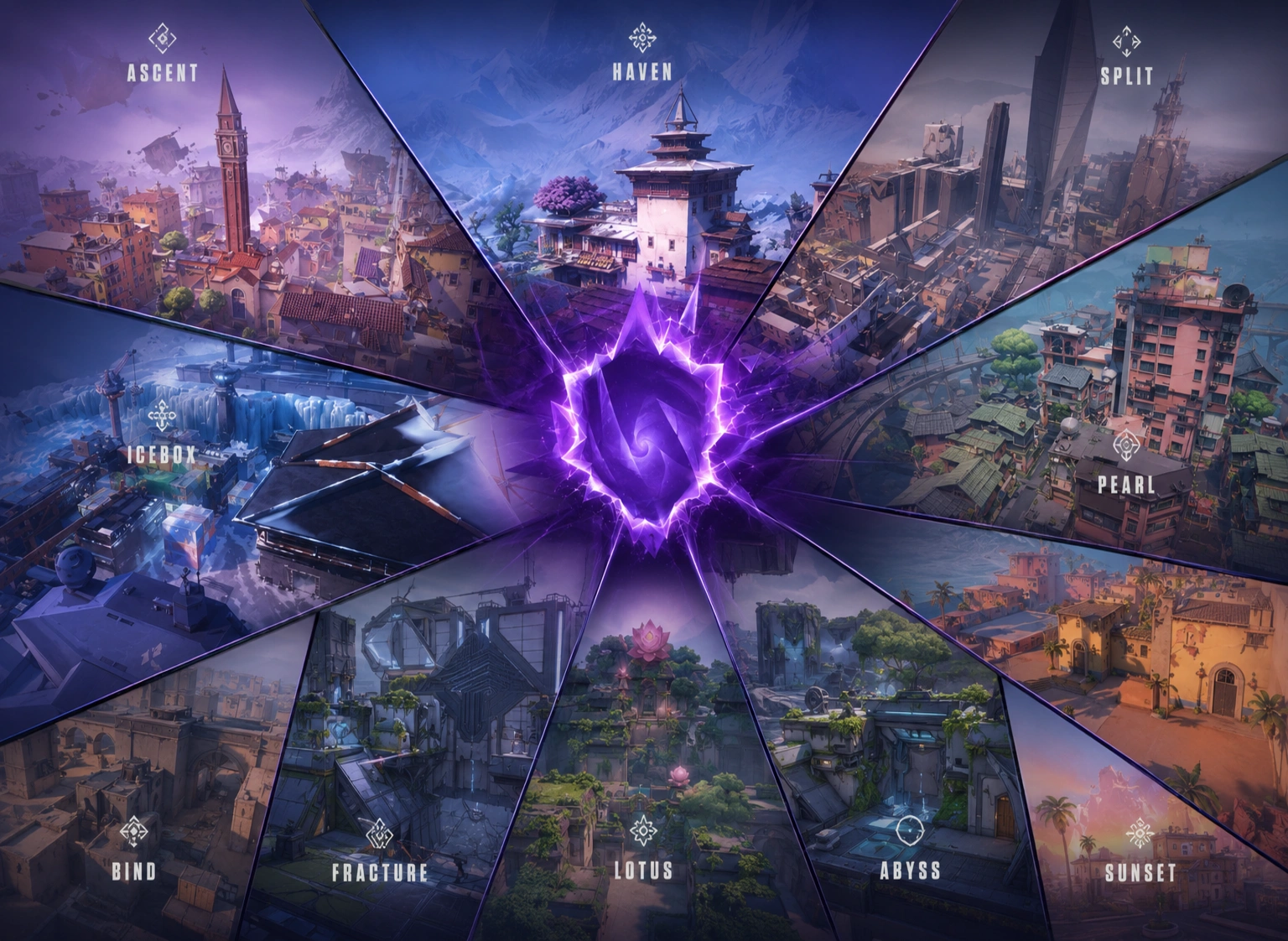
Valo currently features 12 maps in total, and if you actually want to improve instead of endlessly grinding low ranks, you need to understand how these maps truly function. Learning callouts alone won’t carry you very far. You need to understand rotations, site control, utility usage, map pressure, and which agents perform best on each map.
In this list of all Valo Maps in 2026, I’ll go through every map, explain their special mechanics, highlight the most important areas, recommend the strongest agents, and share practical tips that can instantly improve your gameplay.
And if you want to skip the painful ranked grind entirely, check out our Valo Rank Boost services at Gamer Choice.
All Valo Maps in 2026 Quick Summary:
Valo has 12 maps available in 2026, divided between competitive and casual rotations.
The competitive map pool includes Ascent, Breeze, Fracture, Haven, Lotus, Pearl, and Split.
The casual pool currently includes Abyss, Bind, Corrode, Icebox, and Sunset.
Mid control is extremely important on maps like Ascent, Pearl, Split, Corrode, and Sunset.
Breeze heavily rewards long-range aim, Operator control, and strong information gathering.
Haven and Lotus are unique because they feature three spike sites instead of two.
Bind replaces Mid entirely with teleporter mechanics and mind games.
Icebox and Abyss focus heavily on vertical fights, ropes, elevation, and awkward angles.
Valo rewards tactical thinking, discipline, and map mastery. Unfortunately, you won’t see much of that in lower ranks. If you’d rather play with experienced players immediately, check out our Valorant Rank Boost.
Buy Valorant Boost
Climb the Valorant ranks fast with our pros!
Shop now
List of All Valo Maps
Every Valo map has its own personality and mechanics. Some are loved by the community, while others are hated almost universally (yes, Fracture, we’re talking about you.)
At the moment, the game contains 12 maps total, with 7 maps currently available in the competitive pool. The remaining 5 maps are outside the competitive rotation for now, though Riot may bring them back later.
Competitive Pool: Ascent, Breeze, Fracture, Haven, Lotus, Pearl, Split
Casual Pool: Abyss, Bind, Corrode, Icebox, Sunset
This guide isn’t meant to be a full deep-dive breakdown of every single map. Instead, it’s a crash course that gives you the key information, strongest agents, important mechanics, and practical tips that can immediately improve your gameplay.
Most Valo maps are surprisingly deep and can easily require thousands of words to fully explain. Trying to memorize everything at once is unrealistic anyway, which is why shorter and practical advice often works better.
Ascent
Ascent is one of the oldest and most iconic Valo maps. It remains one of the most balanced maps in the game and is still extremely popular among players.
The map features mechanical doors on both bomb sites. A Site has a door connected to A Link, while B Site has one at Market. Both doors start open and can be closed or reopened using switches located on the site side.
Closed doors completely block bullets, but they have 500 HP and can be destroyed permanently for the remainder of the round.
Ascent’s key points are:
Mid
Catwalk
A Tree
B Main
Market
Courtyard also contains two destructible wall panels leading toward Link. Each panel has 400 HP and changes color as it gets damaged. Once destroyed, players can wallbang through those walls for the rest of the round.
There is also breakable glass at A Window facing A Garden. Bullets and many abilities can destroy it instantly.
A few tips to play Ascent better:
Fight for Mid Control: Mid is one of the strongest areas on the entire map. Losing it gives defenders or attackers huge rotational freedom and valuable information.
Split Pushes Work Extremely Well: Ascent is relatively compact, so fake pressure on one site can quickly force defenders to rotate away from the real hit.
Take Ultimate Orbs Early: Attackers benefit heavily from early ultimates on this map. Since Ascent can feel defender-sided at times, gaining ult advantage can completely swing momentum.
The best agents to play on Ascent are:
Sova or Fade: Both agents are incredible at clearing dangerous angles and gathering information.
Killjoy or Cypher: Excellent at locking down B Site and watching flanks.
Omen: One of the strongest controllers on Ascent thanks to flexible smokes around Tree and Market.
Ascent is one of the few maps where almost every team composition can work. It rewards creativity and adaptation more than rigid metas.
Breeze
Breeze is one of the largest and most open maps in Valo. Long sightlines dominate almost every important area, which means careless peeks often get punished instantly.
The A Site area contains a rope that defenders can use to climb toward Bridge and Hall, allowing fast repositioning and support rotations.
Breeze’s key points are:
A Main
Mid
Halls
B Main
Elbow
Mid Hall also contains an automatic door that opens whenever players or abilities move close enough to it. The loud sound cue can instantly reveal rotations or lurking attempts.
This makes Hall control very risky because even small actions can expose your timing.
A few tips for Breeze:
Always Have an Operator Player: Breeze heavily favors Operator users because of its massive sightlines.
Defenders Should Prioritize Mid Nest: Controlling Mid Nest gives defenders incredible rotational control.
Retakes Are Strong: Don’t panic if attackers enter a site. Breeze gives defenders enough room to retake effectively from range.
Execute Properly: A Site entries usually work through Cave, Hall, or split pushes. B Site becomes much easier once Elbow and Main are isolated with utility.
The best agents to play Breeze:
Viper: Easily the strongest agent on the map because of her wall control.
Sova or Skye: Information gathering is incredibly important on such a large map.
Jett: Amazing for aggressive Operator play and fast Mid control.
Breeze becomes extremely difficult for attackers once defenders establish control over chokepoints. Fast and decisive executes are usually the key to success.
Fracture
Fracture has one of the strangest layouts in Valo. Attackers can approach sites from both sides of the map thanks to the split-spawn design.
Before rounds begin, attackers can use one-way ziplines to reposition across the map. Defenders cannot hear these ziplines during Buy Phase.
Fracture’s key points:
A Main
Dish
Drop
B Main
Arcade
The map also contains four ultimate orbs instead of the normal two. One orb exists in each quadrant of the map.
A Hall contains an automatic door that opens whenever players or objects get close enough to it, creating another loud audio cue.
While riding ziplines, players move automatically and cannot use abilities or stop midway.
How to make Fracture less painful:
Play Active Defense: Sitting passively on sites usually doesn’t work. You need to challenge space aggressively.
Actually Use the Ziplines: Many players ignore them entirely despite how useful they are.
Use Fake Pressure: Fracture is massive, so misinformation and rotations are extremely effective.
The best agents for Fracture:
Breach: His utility is devastating in Fracture’s tight spaces.
Brimstone: Great at controlling chokepoints and denying plants.
Sova, Cypher, or Skye: Information is everything on Fracture.
Fracture’s design is exactly why many players dislike it. Rounds often revolve around timing and map control rather than direct fights. Whether that’s fun or not depends entirely on the player.
Haven
Haven’s defining feature is its three-site layout, which forces defenders to spread their resources more thinly than usual.
Despite having three sites, Haven only contains two ultimate orbs located at A Long and C Long.
Haven’s key points:
A Long
A Short
Garage
B Site
C Long
The Garage doors and part of Window are protected by destructible panels with 400 HP. Once broken, players can wallbang those areas for the remainder of the round.
Useful Haven tips:
Control Garage: This is one of the most important areas on the map because it influences both B and C Sites.
Abuse Utility Fakes: Defenders struggle to track three sites simultaneously, which makes fake executes extremely powerful.
Understand Site Dynamics: C Site is easy to enter but difficult to defend post-plant. A and B Sites usually provide stronger setups.
The meta agents for Haven are:
Omen or Brimstone: Smokes dominate Haven’s narrow pathways.
Killjoy or Cypher: Great for stabilizing weaker sites.
Jett or Raze: Both agents rotate quickly and thrive on Haven.
Three-site maps are often controversial, but Haven remains one of the better examples because of its pacing and flexibility.
Lotus
Lotus is the second three-site map added to Valo. Like Haven, it only contains two ultimate orbs.
The map includes ropes, rotating doors, and destructible walls, making it one of the most mechanically complex maps in the game.
Lotus’s key points:
A Main
Rubble
Tree
B Main
C Main
Lotus contains two rotating doors. One connects A Main to A Tree, while the second links C Mound to B Main. Each rotation lasts 10 seconds after activation.
There is also a destructible wall between A Main and A Link with 400 HP.
A few tips to dominate Lotus:
Fight for Rubble: This is one of the strongest control points on the map.
Sentinels Are Incredible: Cypher and Killjoy dominate the narrow pathways around B and C.
Use Doors for Mind Games: You don’t actually have to rotate through them. Simply activating them can bait reactions.
Top agents for Lotus:
Viper: Her wall control is absurdly strong on Lotus.
Killjoy or Cypher: Excellent for controlling rotations and narrow entries.
Omen, Astra, or Brimstone: All controllers work well here.
Lotus can occasionally feel awkward because of the amount of utility and rotations involved, but it generally plays far smoother than Fracture.
Pearl
Pearl is unusual because it has no major gimmicks. No teleporters, no ropes, no rotating doors, and no strange mechanics.
It feels closer to a traditional tactical shooter map, which is exactly why many players enjoy it.
The key points of Pearl are:
Mid
Art
A Lobby
B Long
A & B Links
Tips for Pearl:
Play Around B Long: Attackers usually have the advantage there.
Fight for Mid Early: Giving away Mid often leads to disaster.
Always Have a Lurker: Pearl rotations are long, making lurkers extremely effective.
Best agents for Pearl:
Viper: Yet another map where she dominates.
Sova or Fade: Strong for clearing dangerous corners and angles.
Astra or Harbor: Their utility feels oppressive on Pearl.
Pearl strips Valo down to pure mechanics, utility, and tactical decision-making. That simplicity is exactly why many players love it.
Split
Split has existed since Valo launched and remains one of the most defender-sided maps in the game.
The map heavily emphasizes vertical gameplay through ropes and elevated positions.
The Split’s key points are:
Mid
Mail
Vents
A Heaven
B Heaven
Heaven control is extremely important because attackers usually want post-plant setups focused around elevated angles.
Split’s defining mechanic is its ascenders. Ropes connect multiple lower and upper areas across the map.
Key Split tips:
Mid Control Is Everything: Mid dictates rotations and site pressure.
Plant for Heaven: Most default plants work best with Heaven control.
Utility Wins Rounds: Delaying pushes with utility is incredibly effective.
Best agents for Split:
Raze: Incredible for clearing B Site angles.
Sage: Fantastic for slowing Mid aggression.
Omen or Viper: Great controllers for locking down sites.
Even though Split heavily favors defenders, the map remains exciting because of how explosive rounds can become.
Abyss
Abyss is currently outside the competitive rotation and is probably one of the most gimmicky maps Valo has ever added.
The map has no outer boundaries, meaning players can literally fall to their deaths in multiple areas.
The most important points on Abyss:
Mid
A Main
A Heaven
B Main
Bridge
Several ascenders connect important vertical areas across the map.
Vent also contains destructible doors with 120 HP.
How to win on Abyss:
Use Verticality: Jett and Raze become extremely powerful here.
Play Aggressive Defense: Early aggression forces attackers to waste utility.
Watch Wide Angles: Operator players love Abyss.
The best agents for Abyss:
Omen or Astra: Strong site control and stall potential.
Skye or Sova: Information gathering is incredibly valuable here.
Jett or Raze: Mobility is king on Abyss.
Abyss feels more experimental than competitive. Falling off the map often feels frustrating rather than skillful, which explains why the community remains divided on it.
Bind
Bind was recently removed from the competitive rotation to make room for Ascent.
Unlike most maps, Bind completely removes Mid and replaces it with teleporters.
Here are the most important points on Bind:
A Short
Showers
B Short
B Long
The map contains two one-way teleporters that allow instant rotations between opposite sides of the map.
Every teleporter usage creates a loud sound cue, which creates constant opportunities for mind games and fake plays.
Key tips for playing Bind:
Map Control Matters: You cannot blindly rush on Bind because defenders have many dangerous angles.
Play Around Teleporters: Fake pressure constantly and stay unpredictable.
The meta agents for Bind are:
Raze, Jett, or Neon: Excellent entry fraggers.
Brimstone or Clove: Incredible plant denial.
Skye or Fade: Amazing for clearing tight spaces.
Bind remains one of the community’s favorite maps because teleporters create endless opportunities for outplays and chaotic rounds.
Corrode
Corrode is one of the most divisive maps in Valo.
Unlike maps with flashy mechanics, Corrode is relatively straightforward, though its layout often feels awkward and extremely Mid-focused.
Here are the points you need to look out for on Corrode:
Mid
A Main
B Main
Mid control is absolutely everything on Corrode. Teams that dominate Mid usually dominate the round.
Tips to win on Corrode:
Take Mid Aggressively: Shallow and Deep Mid determine the pace of the round.
Anchor B Site: B heavily favors defenders.
Stay Quiet: Water pathways create loud audio cues.
Best agents for Corrode:
Omen or Viper: Incredible control agents for the map.
Yoru, Neon, or Jett: Mobility is extremely valuable here.
Cypher or Killjoy: Great for stopping predictable pushes.
Corrode often feels closer to a deathmatch map than a tactical FPS map, which explains why opinions on it are so mixed.
Icebox
Icebox introduced horizontal ziplines and extreme vertical gameplay to Valo.
The map heavily revolves around elevation, layered angles, and aggressive site takes.
Here are the key choke points on Icebox:
A Pipes
A Nest
Mid Tube
Kitchen
B Yellow
Both sites contain elevated nest positions where players can plant or defend from above.
How you should play Icebox:
Attack Aggressively: Fast executes are usually stronger than slow defaults.
Abuse Verticality: Elevation changes constantly break crosshair placement.
Plant Properly: A Site plants usually favor Belt, while B Site plants favor Yellow.
The must-pick agents on Icebox:
Viper: Mandatory on this map because of her wall utility.
Sage: Her wall creates safe plants and defensive setups.
Icebox was removed from competitive mainly because it forced teams into very specific compositions and strategies.
Sunset
Sunset is another extremely divisive map within the community.
It follows a more traditional three-lane structure, though Mid remains incredibly important.
Here are the key points:
Mid
Market
B Main
A Main
A Elbow
The map’s special mechanic is the mechanical door between B Market and Mid Courtyard.
The door blocks bullets while closed and has 500 HP before being destroyed permanently.
Tips to play Sunset:
Fight for Mid Immediately: Mid control completely dictates rotations.
Rush A Site: A is generally easier to attack than B.
Best agents for Sunset:
Cypher or Killjoy: Excellent for B control and flank coverage.
Omen or Clove: Strong Mid smokes.
Raze or Jett: Excellent aggressive duelists.
Personally, Sunset feels too close-quarters and chaotic compared to more tactical maps, which is why many players dislike it.
Read our other Valo guides:
Rankings Guide
Best Agents Ranked
Best Settings for FPS
How to Play Valo on Linux
Buy Valorant Accounts
Get Valorant accounts: ranked, fresh, smurfs!
Shop now
F.A.Q.
How many Valo maps are there in 2026?
There are 12 Valo maps in 2026. Seven of them are currently in the competitive pool, while the remaining five are available outside the ranked rotation.
Which Valo maps are in the competitive pool?
The current competitive pool includes Ascent, Breeze, Fracture, Haven, Lotus, Pearl, and Split.
What is the best map for learning Valo basics?
Split is one of the strongest maps for learning the basics because it teaches Mid control, Heaven pressure, proper utility usage, and how to fight around vertical positions.
Which Valo maps have three spike sites?
Haven and Lotus are the two Valo maps with three spike sites. This gives attackers more ways to pressure the defense and forces defenders to spread their setup across more areas.
What are the best Valo maps?
Ascent, Haven, and Bind are usually considered the classic top picks, but Pearl also deserves a mention because of its clean layout and simple tactical structure.